SGI Tesside
Here is where you'll find our monthly schedule for all things SGI-UK for the Teesside District.
Welcome to SGI Teesside and our year of soaring higher towards a youthful Soka Gakkai worldwide.
You’ll find our schedule of events and other news here!
recent posts
- Protected: Teesside District: SGI-UK Activities & Key Dates for October 2026
- Protected: Empower Your Happiness: Buddhist Teachings and Activities in September 2026
- The Architecture of Victory: 5 Surprising Lessons on the Art of Treasuring Each Person
- Protected: Transformative Joy: SGI Events & Activities in August 2026
- The Architecture of Resilience: 5 Surprising Lessons About Joy from Nichiren Buddhism
-
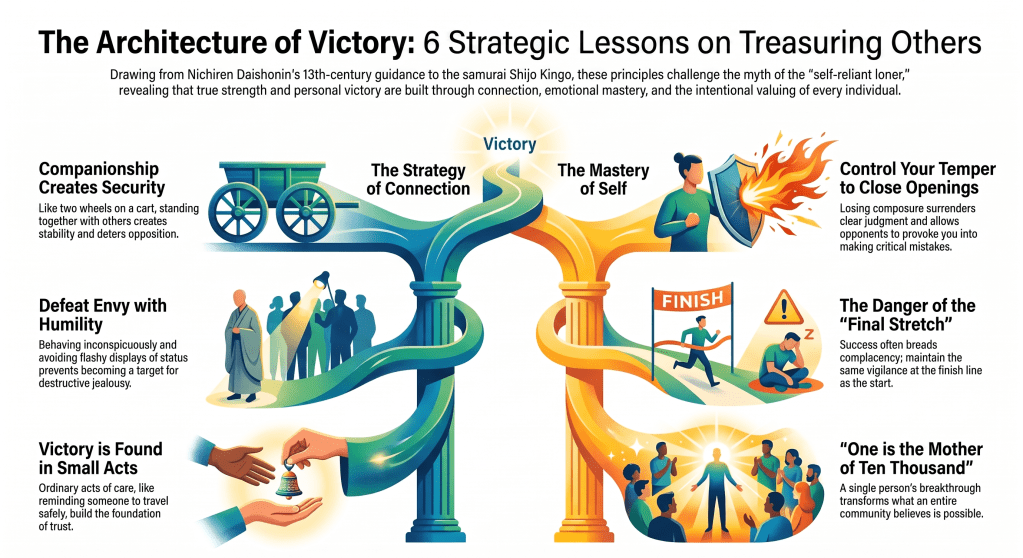
We live in an age that celebrates self-reliance. Strength is often portrayed as standing alone, pushing through challenges without help, and depending on no one but ourselves.
Yet history, human experience, and Buddhist philosophy point to a different truth: isolation is not strength. It is vulnerability.
Nichiren Daishonin’s teaching of treasuring each person offers an alternative vision. Drawing on guidance he gave to the samurai Shijo Kingo during a time of grave danger, we find an unexpected lesson: the surest path to personal victory is not self-protection through separation, but through connection.
What follows are five surprising principles that reveal why valuing others may be one of the most powerful forms of protection and strength.
1. Personal Safety Depends on Partnership
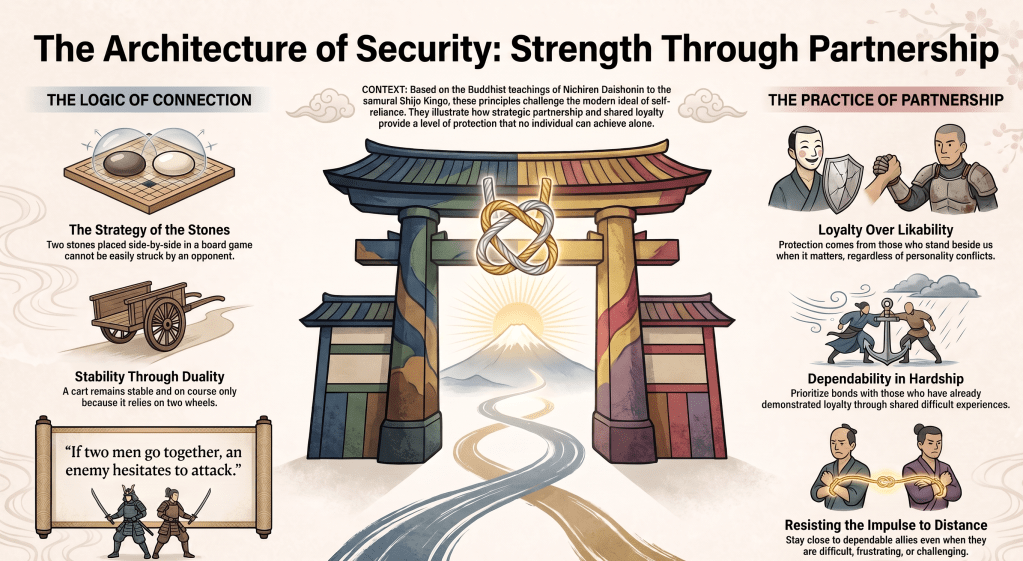
When we’re convinced we’re right, it can be tempting to distance ourselves from people who frustrate us or challenge us. But Nichiren warned against this impulse.
Using an analogy from the board games of his day, he explained that two stones placed together cannot easily be struck by an opponent. Likewise, a cart remains stable only because it has two wheels.
His point was simple: companionship creates security.
Nichiren urged Shijo Kingo to stay close to fellow practitioners, even those he found difficult. These individuals had already demonstrated their loyalty through shared hardship. They were imperfect, but they were dependable.
As he wrote:
“If two men go together, an enemy hesitates to attack.”
In a culture that prizes independence, this is a counterintuitive lesson. The people who protect us most are not always those we like best, but those who stand beside us when it matters most.
2. Losing Your Temper Helps Your Opponents

Most of us justify our anger. We see it as a natural response to unfairness or provocation.
Nichiren saw it differently.
He repeatedly cautioned Kingo about his quick temper, warning that emotional reactions could become an opening for defeat. An enemy does not always attack directly. Often, they seek to provoke us into making mistakes ourselves.
When we lose control, we surrender our greatest advantage: clear judgment.
Nichiren even warned that if Kingo fell because he could not master his emotions, his opponents would celebrate while his allies would suffer.
The deeper battle, then, is not against external circumstances but against the impulses within us that cloud our wisdom.
True strength is not explosive. It is composed.
3. Humility Can Be a Strategic Advantage
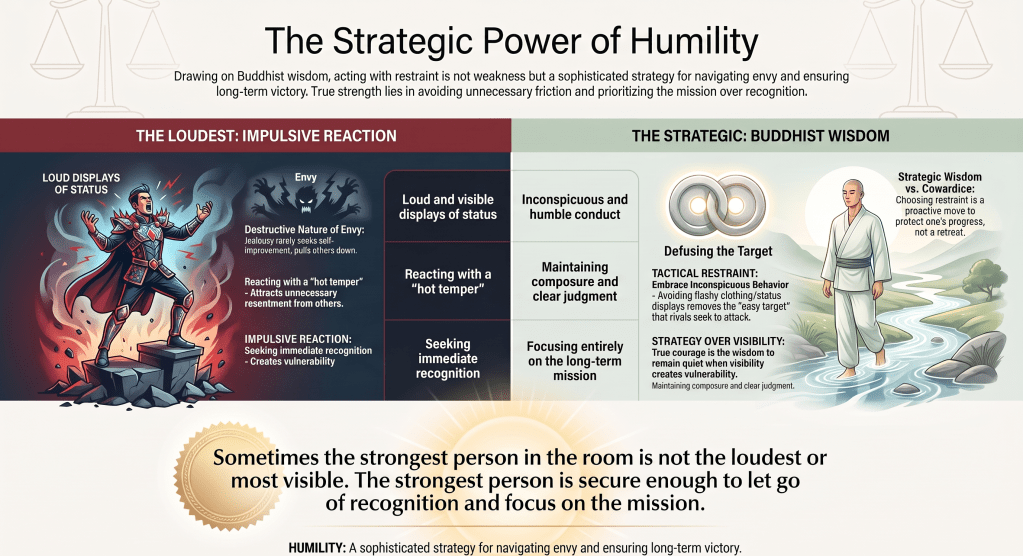
We often associate courage with boldness and visibility. But there are moments when wisdom calls for something else.
Nichiren advised the high-ranking samurai Kingo to behave inconspicuously. He encouraged him to avoid flashy clothing, unnecessary displays of status, and anything that might attract resentment.
Why?
Because envy can be destructive.
Jealousy rarely seeks to improve itself. More often, it tries to pull others down. By acting with humility and restraint, Kingo could avoid becoming an easy target.
This wasn’t cowardice. It was strategic wisdom.
Sometimes the strongest person in the room is not the loudest or most visible. Sometimes it is the one secure enough to let go of recognition and focus entirely on the mission ahead.
4. Greatness Is Revealed in Small Acts

Many people look for spirituality in dramatic experiences, profound words, or grand achievements.
Yet one of the most humanistic insights in Nichiren Buddhism is that compassion shows itself in ordinary moments.
A reminder to drive safely.
A word of encouragement to someone who is struggling.
A sincere question about another person’s well-being.
These small interactions can seem insignificant, but they are the building blocks of trust, hope, and community.
Daisaku Ikeda often emphasized that the true measure of a person is not found in titles or status, but in how they treat others.
Real leadership is revealed in the details.
It is expressed through consistent acts of care that help others feel seen, respected, and valued.
5. Success Is Often the Most Dangerous Moment
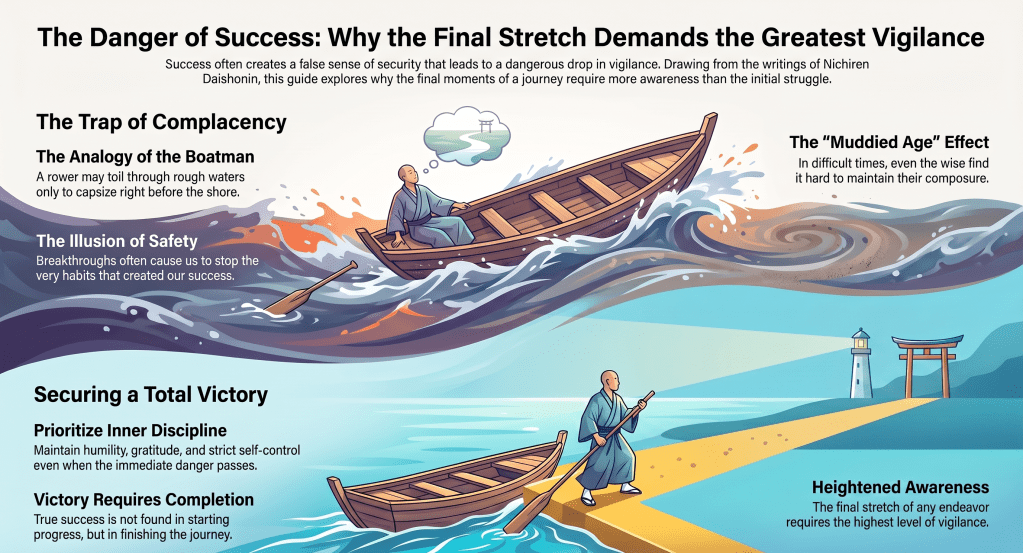
Most people expect challenges during times of struggle.
Few expect them after a breakthrough.
Nichiren compared this danger to a boatman who rows tirelessly across rough waters, only to capsize just before reaching shore.
The lesson is timeless.
Success can create complacency. Once the immediate danger appears to have passed, we relax our vigilance. We stop doing the very things that helped us succeed in the first place.
Humility, discipline, and gratitude become easier to neglect.
Yet victory is not secured when progress begins. It is secured when we finish the journey.
The final stretch often requires the greatest awareness.
The Ripple Effect of One Person’s Victory
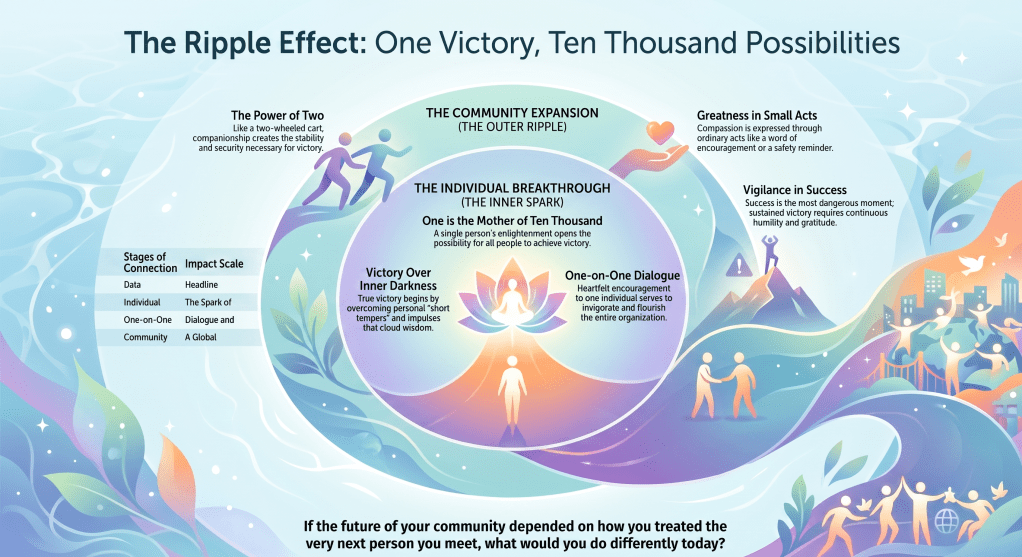
Nichiren Buddhism teaches that “one is the mother of ten thousand.”
In other words, a single person’s breakthrough can open possibilities for countless others.
The story of the Dragon King’s daughter illustrates this principle. Her attainment of enlightenment was not merely a personal achievement. It transformed what others believed was possible.
Our lives work in much the same way.
Every interaction strengthens or weakens the fabric of our communities. Every act of encouragement, patience, and respect creates a ripple effect that extends far beyond what we can see.
In today’s fragmented world, treasuring each person is more than a moral ideal. It is a practical strategy for building resilient relationships, strong communities, and enduring victories.
Perhaps the question is not whether other people matter to our success.
Perhaps the question is this:
If the future of your community depended on how you treated the very next person you meet, what would you do differently today?
-
We live in a world that often tells us happiness means avoiding problems. Social media, self-help advice and modern culture can make it seem as though a good life is one without stress, setbacks or discomfort.
The trouble is that life doesn’t work like that.
Nichiren Buddhism, sometimes called the “Buddhism of the Sun”, offers a very different view. It teaches that nobody can avoid difficulties, not even the wisest people. Rather than seeing problems as something that prevents happiness, it sees them as opportunities to grow stronger and wiser.
From this perspective, joy is not simply a pleasant feeling. It is the strength and determination to keep moving forward whatever happens.
Here are five surprising lessons about joy from this philosophy.
1. Joy Is a Choice, Not Just a Feeling
Many people think joy comes from having an easy life. Nichiren Buddhism teaches the opposite.
Real joy comes from challenging negativity, both around us and within us. The struggles we face can help us grow, develop confidence and bring out our best qualities.
Instead of trying to avoid difficulties, we can see them as opportunities for personal growth.
Nichiren encouraged people to accept both happy and difficult times as natural parts of life:
“Suffer what there is to suffer, enjoy what there is to enjoy. Regard both suffering and joy as facts of life, and continue chanting Nam-myoho-renge-kyo, no matter what happens.”
When we stop expecting life to be perfect, we become better able to deal with whatever comes our way.
2. Challenges Can Become a Sense of Purpose
People often think of karma as fate or punishment. Nichiren Buddhism takes a different approach.
It teaches that our struggles can have meaning and purpose. Rather than asking, “Why is this happening to me?”, we can ask, “What can I learn from this?” or “How can I use this experience to help myself and others?”
Nichiren compared personal growth to forging iron. Iron becomes stronger through heat and repeated hammering. In the same way, people often grow through hardship and challenge.
The point is not that difficulties are enjoyable, but that they can help us become stronger, wiser and more compassionate.
Defeat lies not in encountering difficulties but in not challenging them.
3. You Already Have More Strength Than You Realise
Nichiren Buddhism teaches that every person has great potential within them.
One traditional story tells of a man who lives in poverty without realising a priceless jewel has been sewn into his clothing. His wealth was there all along, but he didn’t know it.
In the same way, we often underestimate ourselves.
Another metaphor is that of a mirror covered in dust. The mirror already has the ability to reflect clearly, but it needs regular polishing. Through self-reflection and Buddhist practice, people can uncover the wisdom, courage and compassion that already exist within them.
The message is simple: you do not need to become a different person. You need to discover the strengths you already possess.
4. Don’t Depend on the Approval of Others
Modern life encourages us to seek validation from other people. It can be tempting to judge ourselves by likes, comments and public approval.
Nichiren warned against this way of thinking.
He believed that people who stand by their values will not always be popular. Sometimes doing the right thing means accepting criticism or standing alone.
One of his most famous statements is:
“To be praised by fools, that is the greatest shame.”
While the wording may sound harsh today, the point is that self-respect and integrity matter more than popularity.
When we stop relying on the approval of others, we are freer to live according to our own principles.
5. Everyone Has the Potential to Change
One of the most powerful ideas in Nichiren Buddhism is that every person has the ability to transform their life.
This is not limited by gender, social background, education or past mistakes. Everyone has the potential for growth and happiness.
When Nichiren Buddhism began spreading in the United States during the 1960s, many of the early practitioners were Japanese women who had moved there after marrying American servicemen. Their experiences helped demonstrate that these ideas could be applied by ordinary people in everyday life, regardless of culture or background.
The message was clear: the potential for personal transformation belongs to everyone.
Conclusion
The central lesson of this philosophy is simple: happiness does not come from avoiding difficulties.
Instead, lasting joy comes from facing life’s challenges with courage, learning from them and refusing to be defeated by them.
Problems are not always obstacles standing in the way of happiness. Sometimes they are the very things that help us develop strength, wisdom and resilience.
So perhaps the question is not:
“How can I avoid my challenges?”
But rather:
“What might this challenge help me become?”
-

We’ve all been there. You start the year with a fire in your belly, a gym membership in hand, and a resolve to finally write that book or heal that relationship. But then, a few weeks in, the “New Year’s fade” sets in. Or worse, the moment you decide to step up, life seems to throw a curveball—a sudden bill, a cold, or a conflict at work.
It’s tempting to see these hurdles as a sign from the universe to stop. But in Nichiren Buddhism, we look at it through a completely different lens. What if those sudden problems weren’t “stop signs” at all? What if they were actually the “lift” you need to take flight? In this philosophy, encountering negativity after making a positive change is actually a high-five from the universe—it’s the absolute proof that you are moving in the right direction.
Resistance is the “Lift” that Makes You Fly
Think about how an airplane works. An aircraft doesn’t just drift into the sky; it needs to build up incredible speed on the runway. As it moves faster, it encounters air resistance. It’s that very resistance that creates the “lift” necessary to keep the plane airborne and propel it toward its destination. Without the wind pushing against the wings, the plane would never leave the ground.
In our lives, the stronger the “positive cause” we make—whether that’s working toward our own growth or contributing to the happiness of others (what we call the kosen-rufu movement)—the stronger the negative resistance will be. This shift in perspective is incredibly empowering. When you feel the “wind” of life pushing back, you can smile and realize it’s not a barrier; it’s the propulsion required for your breakthrough.
The “Three Obstacles and Four Devils” Roadmap
To navigate the storms of life, Buddhism provides us with a roadmap called the “three obstacles and four devils.” If we know the names of the signs on the road, we aren’t as easily frightened when we see them.
The Three Obstacles usually manifest as external environmental blocks:
- The obstacle of earthly desires: Negativity fueled by greed, anger, or foolishness.
- The obstacle of karma: Challenges arising from our own past negative actions.
- The obstacle of retribution: Resistance from those in authority or even family members who may try to obstruct our path.
The Four Devils (or hindrances) are more internal and insidious:
- The devil of earthly desires: Being swayed by our own cravings or delusions.
- The devil of the five components: Physical or mental illness that saps our energy.
- The devil of death: The paralyzing fear or doubt that arises after the loss of a loved one.
- The devil king of the sixth heaven: The personification of extreme, life-force-sapping negativity.
It’s worth noting that while there are three external obstacles, there are four internal devils. This reminds us that while we should be aware of our surroundings, we must keep an even closer watch on our own inner state. As Nichiren Daishonin famously wrote:
“There is definitely something extraordinary in the ebb and flow of the tide, the rising and setting of the moon, and the way in which summer, autumn, winter and spring give way to each other. Something uncommon also occurs when an ordinary person attains Buddhahood. At such a time, the three obstacles and four devils will invariably appear, and the wise will rejoice while the foolish will retreat.”
Understanding the “Devil King” (And Why He’s Worried About You)
The “Devil King of the Sixth Heaven” sounds like a literal monster, but Buddhism describes him more like a ridiculous, high-drama character in a pantomime. He represents the peak of negativity that is terrified of you becoming happy and independent.
Why? Because when you reveal your “Buddha nature,” you not only free yourself from suffering but you empower everyone around you to do the same. This “vexes” the Devil King because he loses his domain. In the texts, he’s described as summoning his “underlings” from across the “threefold world” (the worlds of desire, form, and formlessness) to harass you. If that doesn’t work, he tries to possess the minds of your friends or people in power to threaten you.
By demystifying this force, we can see negativity for what it is: a desperate, last-ditch effort by our own delusions to stop our progress. When things get weirdly difficult, you can almost hear the Devil King’s frustration—and that’s a sign you’re winning.
The Wise Rejoice: How to React to Trouble
The difference between success and failure isn’t the absence of problems; it’s our reaction to them. The “foolish” retreat when things get hard, but the “wise” actually rejoice.
Why rejoice in a struggle? Because the appearance of these obstacles is the “guarantee” that you are close to a major enlightenment. The great teacher T’ien-t’ai offered a vital warning on how to stay the course:
“One should be neither influenced nor frightened by them. If one falls under their influence, one will be led into the paths of evil. If one is frightened by them, one will be prevented from practising the correct teaching.”
When we get scared, we stagnate. When we keep a steady, uninfluenced heart, we move through the barrier.
The Oneness of Self and Environment
A core principle in my practice is “the oneness of self and the environment.” This means our surroundings are essentially a mirror reflecting our inner life. If we hold onto a pessimistic heart, we tend to draw out negative responses from the world around us. Conversely, a positive, determined inner state draws out harmony.
However, we have to be honest with ourselves. Sometimes being late for a meeting isn’t a “spiritual attack”—it’s just bad planning or transport issues! True “negativity” is that specific energy that tries to make you abandon your belief in yourself. The environment responds to our inner breakthrough; as we change our hearts, the “obstacles” in our environment eventually transform into the very tools of our victory.
The “Come At Me” Mindset: Forging an Unshakable Spirit
Daisaku Ikeda often teaches that difficulties aren’t walls—they are “doors waiting to be opened.” Whether a trial is a misfortune or a stroke of good luck depends entirely on your resolve. We forge our spirit by challenging these things head-on. The ideal state is one of “profound elation” when things get tough.
In Nichiren Buddhism, we use the practice of chanting Nam-myoho-renge-kyo to raise our life-condition. This allows us to look at a mountain and say:
“With a dauntless spirit, we can lead a cheerful and thoroughly enjoyable life. We can develop a self of such fortitude that we look forward to life’s trials and tribulations with a sense of profound elation and joy: ‘Come on obstacles! I’ve been expecting you! This is the chance that I’ve been waiting for!’”
Your Heart is What Matters Most
At the end of the day, everything is determined by your inner resolve. The Argentine poet Almafuerte once wrote: “To the weak, difficulty is a closed door. To the strong, however, it is a door waiting to be opened.”
By tapping into your Buddha nature, you gain the capacity to transform any obstacle into a stepping stone for growth. Your heart is the most powerful tool you own. It determines whether you see a barrier or a breakthrough.
The next time you face a “closed door” in your life, take a breath and remember the airplane. Will you see the resistance as a reason to stop, or will you recognize it as the sign that you are finally ready to take flight?
-
We are living through a masterclass in uncertainty. Navigating the “turbulent waters” of our current era—marked by the stark realities of social inequality, systemic racism, and global health crises—can feel like trying to find a fixed point in a storm. In this chaotic landscape, we are often told to find a mentor, usually framed as a corporate elder or a professional coach who can show us the ropes.
But what if we’ve been looking at mentorship through the wrong lens? What if the most transformative guidance doesn’t come from someone who “chooses” you for an apprenticeship, but from a spiritual anchor you actively claim for yourself? The Nichiren Buddhist tradition offers a revolutionary take on this bond, suggesting that the most powerful connection isn’t found in physical proximity, but in the architecture of the heart.
Proximity Is a Myth: The Heart Is the Only Real Connection
We’ve been conditioned to believe that for a relationship to be real, it requires “face time.” We measure intimacy by proximity. However, the story of the 13th-century lay nun Sennichi and her husband, Abutsu-bo, shatters this delusion.
While Abutsu-bo made the treacherous, grueling journey across mountains and seas from Sado Island to visit their mentor, Nichiren Daishonin, on Mount Minobu, Sennichi remained behind to guard their home. Physically, she was isolated. Spiritually, she was closer than those standing in the same room as the mentor. Nichiren wrote to her:
“Though we live in the impure land, our hearts reside in the pure land of Eagle Peak. Merely seeing each other’s face would in itself be insignificant. It is the heart that is important.”
To a modern ear, the “Pure Land of Eagle Peak” isn’t a destination on a map; it represents a state of enlightened consciousness—the highest potential of the human spirit. Nichiren was telling Sennichi that because her heart was aligned with the mission of alleviating suffering, she was already there.
In our digital age, we have “infinite connection” via social media that often feels profoundly hollow. We see faces on screens but rarely feel the weight of a shared soul. The Buddhist perspective offers a different kind of connection: one based on shared struggle and purpose. Geographic distance is irrelevant when two people are committed to the same transformative ideals.
The Disciple Is the Active Architect
The greatest misconception about mentorship is the “waiting game”—waiting for a master to recognize our potential and bestow their wisdom upon us. In reality, the power dynamic is reversed. The disciple is the architect of the relationship.
Mentorship is a catalyst. A masterful educator doesn’t just give advice; they inspire a student to move more quickly and in a better direction than they ever could alone. But this acceleration only happens when the disciple possesses a “seeking spirit.”
This explains how some of history’s most powerful mentor-disciple bonds spanned centuries. Martin Luther King Jr. never met Mahatma Gandhi, yet by single-mindedly studying Gandhi’s nonviolent resistance, he claimed Gandhi as his mentor and changed the course of American history. Similarly, Tsunesaburo Makiguchi founded the Soka Gakkai by seeking out Nichiren Daishonin’s heart across a 700-year gap.
This is the essence of the Buddhist phrase isshin yokken butsu, or “single-mindedly desiring to see the Buddha.” It isn’t a physical longing to see a person; it is a state of mind—an internal fire to understand and embody the mentor’s courage in one’s own life. You don’t wait to be chosen; you choose to seek.
Mentorship as a Constant Internal Dialogue
This relationship isn’t a one-time achievement or a certificate on a wall; it’s a lifelong pursuit. It functions as an internal compass, helping you move from a passive observer of your life to an active participant who takes full responsibility for your own happiness and the happiness of others.
The mechanism for this “seeking spirit” is a constant internal dialogue. It’s the process of looking at a crisis and, rather than being paralyzed, asking three practical questions:
- How can I apply these principles today?
- What can I do to help those around me?
- In this situation, how would my mentor pray and act?
By engaging in this reflection—seeking answers through study and action—you align your rhythm with a greater purpose. You aren’t just following a person; you are mirroring a spirit to reveal your own greatest potential.
Beyond the Individual: Navigating the Storm
The mentor-disciple bond is ultimately more than a tool for personal growth; it is a prerequisite for social transformation. By anchoring ourselves in the wisdom of those who came before us, we find the fortitude to confront modern crises—from racism to global instability—with confidence rather than despair. As Ikeda Sensei writes:
“The hearts of those who struggle courageously… to realize kosen-rufu in the place where they are… are one with Nichiren Daishonin’s heart.”
When we align our hearts with a mentor dedicated to kosen-rufu—the movement for world peace and societal happiness—we find the strength to lead fulfilling lives regardless of the “turbulent waters” around us.
In a world that feels increasingly disconnected, we have the power to build an unseen bridge. The question is: Who are you seeking to help you navigate your own journey?
-
Imagine standing in a quiet corner of a living room, where the faint, woody scent of incense lingers in the air. Before you sits the butsudan—a wooden cabinet whose doors have been clicked open to reveal a scroll of intricate calligraphy. In the soft glow of a candle, your eyes are drawn to the bold black ink trailing down the center.
To a guest, this might look like a beautiful piece of religious art or an ancient relic. But for those in the SGI-UK community, this scroll—the Gohonzon—is a piece of spiritual technology. It is not an object to be worshipped in the traditional sense, but a “map” of the human psyche at its most enlightened. By exploring what this scroll represents, we can begin to see our own lives through a much wider lens.
The Fusion of Person and Law: You Are the Buddha
At the very heart of the Gohonzon are large, striking characters that read Nam-myoho-renge-kyo followed by the name Nichiren. This is the first “truth” that upends most Western conceptions of religion: the “Person” and the “Law” are presented as one.
In many traditions, the divine is a distant figure on a pedestal, far removed from the messiness of human life. Nichiren Buddhism flips this. The Gohonzon represents the moment Nichiren awakened to the “Mystic Law” within his own life and realized it was synonymous with the world of Buddhahood. By placing his name alongside the Law, he was signaling that the Law doesn’t exist in a vacuum—it only comes alive through a human being.
Our focus of attention is usually on the character Myo, the core of the Mystic Law. Why? Because Myo represents the principle that every single person, regardless of their past or current circumstances, possesses the inherent potential for enlightenment. Even the figures of Fudo and Aizen—traditionally representing intense anger and earthly desires—are included on the scroll. This teaches us that Buddhism isn’t about deleting our “difficult” emotions; it’s about revealing that even our passions and intensities are “functions of life” that can be unified within an enlightened life state.
The Mirror Effect: Why You Must Never Look “Outside”
One of the most profound ways to understand the Gohonzon is to view it as a “clear mirror to observe one’s mind.” When we chant before it, we aren’t praying to the paper to fix our problems; we are using the scroll as a reflective surface to see our own internal reality more clearly.
Most of us are conditioned to look for happiness and solutions “out there”—in a better career, a perfect partner, or a change in scenery. We often feel like victims of our environment. This practice demands a radical shift in responsibility.
“Never seek this Gohonzon outside yourself.”
When we stop seeking external saviors, we realize that the source of our suffering and the power to overcome it both reside within us. The Gohonzon serves as a constant, physical reminder that Buddhahood is a permanent, internal fixture of our lives. It is a tool that forces us to look inward, where the actual work of transformation happens.
The “Paper” Paradox: The Role of Faith and Practice
There is a provocative statement in Nichiren’s teachings: without the human element of faith and practice, the Gohonzon is “simply a piece of paper.” This “Paper Paradox” is what makes the practice modern and practical.
Think of the Gohonzon like a high-end smartphone. On its own, it is a dormant collection of glass, metal, and silicon. It only becomes a powerful communication tool when it is charged and operated by a user. Similarly, the Gohonzon is an “object of devotion” that requires our active engagement to “activate.”
This activation happens through two pillars: faith (the conviction that we are Buddhas) and practice (the action of chanting). It is the practitioner’s own life-force and intent that breathes life into the mandala. This reminds us that spiritual tools are only as powerful as the person using them. The Gohonzon doesn’t “do” the miracle for us; it provides the focus necessary for us to tap into our own latent wisdom and courage.
More Than Meditation: The “Banner” of a Global Mission
While chanting can bring a deep sense of personal peace, the Gohonzon was never intended for “quietism” or escaping the world. Nichiren Daishonin described it as the “banner of propagation of the Lotus Sutra” (WND-1, 831).
A banner is something you carry forward into the world; it is a symbol of identity and mission. This mission is rooted in the “Ceremony in the Air,” a metaphorical event described in the Lotus Sutra where the mission of spreading the Law was entrusted to the “Bodhisattvas of the Earth.” In the SGI-UK framework, we are those Bodhisattvas.
This means the practice is fundamentally about kosen-rufu—a Japanese term for the widespread propagation of the Mystic Law to create a peaceful society. It is “Buddhism in Action for Peace.” To have faith in the Gohonzon is to align ourselves with the mission of spreading the belief that every human life is of ultimate value. Our personal transformation is the engine for a much larger social transformation.
Conclusion: A Final Thought for the Modern Seeker
The Gohonzon remains a vital tool today because it moves “enlightenment” out of the clouds and onto the ground of our daily existence. It tells us that we don’t have to be perfect to be Buddhas; we just have to be willing to look in the mirror.
By viewing the Gohonzon as a map of our own highest potential, we stop being victims of our circumstances and start being the architects of our own lives. We shift from the mindset of “I am struggling with my life” to “My life is a work of art in progress.”
If the Gohonzon is a mandala of the Buddha’s life, what would change today if you began viewing your own life as a mandala of limitless potential?
-
This post delves into the deeper meaning of Nam Myoho Renge Kyo
1. Introduction: The Universal Feeling of Being “Stuck”
We all know the claustrophobia of a life that has stopped breathing—the “deadlock” where every effort yields no movement. It is a peculiar kind of paralysis, a feeling that we are standing on the outside of a world that is moving on without us. Whether it manifests as a creative block, a stale relationship, or a career that has reached a silent plateau, the sensation is the same: we feel disconnected from the vital current of life.
In the spiritual tradition of SGI-UK, this stagnation is viewed through a transformative lens. The practice of Nam-myoho-renge-kyo offers a framework where these moments of deadlock are not seen as permanent walls, but as phases in a deeper, rhythmic process. This is “Buddhism in Action for Peace”—a practical philosophy that treats every stalemate not as a finality, but as a site for profound internal revolution. By understanding the mechanics of this Law, we begin to see that even when we feel most stationary, we are part of a majestic movement toward change.
2. The Invisible Rhythm: Beyond What We See (Myoho)
In our modern obsession with the “manifest”—the visible promotion, the tangible victory, the outward shift—we often ignore the silent architecture that supports it. The concept of Myoho reveals that life operates as a continuous, elegant rhythm of “latent-manifest-latent-manifest.”
This Law is observable everywhere in the natural world. Consider the seasons: the explosion of spring is not a sudden miracle; it is the inevitable manifestation of the latent preparation of winter. Consider our own psychology: a state like anger remains latent within us, invisible and quiet, until a specific stimulus calls it to the surface. Even on a cosmic scale, the birth and death of stars follow this same pulse of emergence and withdrawal.
“Everything is moving in a rhythm of latent-manifest-latent-manifest. That life is not just what we see (manifest) but is also what is latent.”
When we focus only on what is visible, we feel despair during the “latent” periods of our lives. But Myoho teaches us that the rhythm is always moving. Just because a breakthrough isn’t visible yet doesn’t mean the Law of life has stopped working.
3. The End of the Waiting Game: Simultaneous Cause and Effect (Renge)
Most of us are conditioned to live in a state of sequential delay. We assume that we must make a cause today and then wait—days, months, or years—for the effect to arrive. This “waiting game” is the primary source of our feeling “stuck,” as we remain tethered to past failures while waiting for a future result.
The concept of Renge, symbolized by the Lotus Flower, dismantles this linearity. In nature, the lotus is unique because it produces flowers and seeds at the exact same time. This serves as a metaphor for a hope-filled truth: internal cause and internal effect are simultaneous.
In Nichiren Daishonin’s Buddhism, the internal cause we make by chanting Nam-myoho-renge-kyo creates an immediate internal effect. There is no lag. This insight is a powerful weapon against stagnation because it means we need never face a true deadlock. We are never truly “stuck” because the moment we engage with our lives through this practice, the internal reality has already begun to shift. The effect is instantaneous.
4. The Vibration of Connection: Sound as a Universal Bridge (Kyo)
How do we bridge the gap between our individual struggles and the vastness of the universe? The answer lies in Kyo—the power of sound and vibration.
Sound is inherently boundless. It moves through us and around us at the same time, ignoring physical limits to interconnect different realities. Chanting is not a passive meditation; it is an active use of vibration to connect our lives with the “awakened heart of the living universe.” This connection knows no boundaries, linking the individual to the entirety of life throughout the universe. Through Kyo, we move beyond perceived isolation and align our personal vibration with the majesty of life itself.
5. The Deliberate Act: Choosing Compassion (Nam)
Change is not a passive event that happens to us; it is a deliberate act of alignment. Nam represents this active, conscious element of the practice. It is the decision to move out of the passenger seat and take the wheel.
This is a vital distinction from passive thinking. While some philosophies suggest waiting for a mood to change or for a problem to dissolve, Nam is an act of “compassionately connecting ourselves” with the great working of life. It is the bridge between our individual will and the universal Law. By choosing Nam, we transition from being victims of circumstance to being active participants in the majesty of life.
6. Conclusion: Navigating the Inner Battle
Ultimately, these insights shift our understanding of life from a series of static problems to a profound Law of movement and connection. Challenges do not disappear, but our capacity to navigate them changes.
The practice involves a constant “inner battle with our negativity”—the small, quiet voice that insists we are stuck. To change our reality, we must chant with the conviction that we are already part of a universal rhythm of change. When we view our lives through the lens of simultaneous cause and effect, the very concept of “deadlock” begins to dissolve.
As you look at a current challenge in your life, ask yourself: How would my approach change if I viewed this “stuck” moment as the latent phase of an inevitable rhythm, and knew that my next internal shift would produce an immediate effect?
-
You are having a perfect day—until you aren’t. One moment, you’re enjoying the quiet of a sunny afternoon, the world feeling balanced and bright. Then, a neighbor’s music blares through the wall—too loud and entirely the wrong genre. In a heartbeat, your internal sanctuary dissolves, replaced by a suffocating wave of frustration.
This sudden, jarring shift is more than just a bad mood; it is a glimpse into a sophisticated framework of human consciousness known in Nichiren Buddhism as the “Ten Worlds.” Rather than viewing our emotions as random or external, this psychological model suggests we possess ten distinct life-states that dictate how we perceive and respond to everything around us. It is a map of the internal landscape that offers a startlingly modern way to navigate the complexities of the self.
Hell is a Life-State, Not a Location
In popular culture, “Hell” is often depicted as a fiery subterranean prison—a place of punishment where one is sent. Buddhist psychology, however, offers a more immediate and empowering definition: Hell is a very real, internal experience where we feel “imprisoned by our circumstances.”
This shift in perspective is transformative. When Hell is viewed as a life-state rather than a destination, it moves the focus from passive punishment to active internal experience. It is the feeling of being trapped by suffering or annoyance, where the world seems restrictive and overwhelming. By recognizing Hell as a psychological condition, we reclaim the agency to change it.
The “Quiet” Arrogance of the World of Anger
We typically associate anger with explosive outbursts or violence. However, this framework provides a counter-intuitive and highly relevant insight: the “World of Anger” is often a “quiet world” dominated by the “small ego.”
In this state, a person isn’t necessarily screaming; they are judging. It is a condition defined by a relentless need to feel superior. In this life-state:
“This world is not about being angry, instead it is usually quite a quiet world, but one that is dominated by our small ego and therefore demonstrates arrogance and contempt.”
In daily life, this manifests as a “disdainful opinion” of others—like looking down on a neighbor’s taste in music or dismissing someone’s intellect. Identifying this state helps us catch the subtle ways our ego creates distance and friction through quiet contempt.
The Dark Side of Being “Chill”
The state of “Tranquillity,” sometimes called “Humanity,” is a calm, rational condition where things feel “just right.” It is the mental equivalent of being on holiday—a necessary state for recharging and recovering from life’s inevitable challenges.
However, even our most peaceful moments carry a “positive and negative side.” While reasonableness is a virtue, an excess of tranquillity can decay into “extreme laziness.” This “dark side of chill” suggests that remaining stagnant in a state of rest, while comfortable, eventually hinders growth. True balance requires the awareness that even our most “positive” states can become traps if they lack direction.
The Lower Six vs. The Higher Four
The Ten Worlds are categorized into two groups that define our relationship with the environment. The first group, known as the “lower six,” are essentially reactive. These states—Hell, Hunger, Animality, Anger, Tranquillity, and Rapture (also known as Heaven)—are triggered when our “personal buttons” are pushed.
For example, a heart-warming message might send us into “Rapture,” where our heart sings. This might quickly shift into “Hunger”—a state of constant yearning for objects, people, or experiences we believe will improve our lives. If we feel threatened, we might drop into “Animality,” operating on basic instincts like the fear of a “dangerous” neighbor. In these six worlds, we are at the mercy of our surroundings.
In contrast, the “higher four” worlds require conscious effort to manifest. These include “Learning” and “Realisation,” where we seek wisdom through the experience of others or personal insight. Higher still is the “Bodhisattva” state—a compassionate and altruistic condition where we actively work to take away the suffering of others and replace it with something positive. Finally, there is “Buddhahood,” a dynamic and creative state that represents the pinnacle of the human experience.
The “Mutual Possession” of 100 Worlds
The true sophistication of this analysis lies in a concept attributed to the thinker T’ien-t’ai (also known as Chih-i): the “mutual possession of the Ten Worlds.”
The theory suggests that we each have a “basic” life-condition that acts as a lens through which we view everything else. For instance, a “laid-back” person might have Tranquillity as their base, experiencing even their hunger or anger in a tranquil, measured way. Conversely, someone driven by their ego will experience tranquillity or fear through the lens of Anger.
Because each of the ten worlds contains the potential for all ten within it, there are actually 100 possible life-states at play (10 x 10 = 100). This “100 versions of you” explains why two people can have vastly different reactions to the exact same situation; they are simply looking through different psychological lenses.
Buddhahood as a Foundation, Not an Escape
The goal of Buddhist practice isn’t to escape our emotions or “ascend” to a state where we no longer feel. Instead, the aim is to establish “Buddhahood”—characterized by courage, compassion, wisdom, and life-force—as our fundamental foundation.
A person in the state of Buddhahood still experiences the other worlds. They still feel the pangs of hunger, the heat of anger, and the joy of rapture. The difference is that from the vantage point of Buddhahood, these states become tools used to “create value” rather than destructive forces. This state is uniquely powerful because:
“This world of Buddhahood is the only one that is purely positive.”
By making this dynamic and creative state our “base,” we can navigate even the darkest of the lower worlds without being controlled by them.
Conclusion: Navigating Your Internal Landscape
Understanding these 100 worlds provides more than just a vocabulary for our moods; it provides a map for personal growth. It moves us from being reactive victims of our environment to becoming conscious architects of our own experience.
When we recognize which “buttons” are being pushed, we gain the clarity needed to shift our perspective. If you looked through the lens of Buddhahood today, how would your most “annoying” circumstance transform into an opportunity to create value?
——————————————————————————–
Further Reading
To explore the Ten Worlds and Buddhist psychology in greater depth:
- The Buddha in Daily Life by Richard Causton: A comprehensive introductory guide to these concepts.
- The Writings of Nichiren Daishonin: See “The Object of Devotion for Observing the Mind” (Vol. 1, pp. 354-5) for a foundational perspective.
- SGI-UK Study Materials: Professional resources and grades of study focusing on the “Basics of Buddhism.”
-
Every January, the phrase Blue Monday resurfaces — a cultural shorthand for the “saddest day of the year.” It’s a catchy idea, but not a scientific one. Still, it lands with people because it names something familiar: the heaviness that can settle in after the festive glow fades, when the days are short and our motivation feels thin.
But what if Blue Monday didn’t have to be a low point? What if it could be a turning point?
In Buddhist practice, especially in the teachings of Nichiren, there’s a powerful idea that every moment contains the potential for renewal. Not in a grand, dramatic way, but in the quiet decision to begin again — to choose courage, hope, or compassion right where we are.
This is the heart of human revolution: the belief that small shifts in our inner life ripple outward into our relationships, our work, and our communities.
So instead of accepting Blue Monday as a dip in the calendar, we can transform it into something more meaningful.
1. A Day to Pause and Reconnect
Rather than pushing through the fog, Blue Monday can be an invitation to check in with ourselves.
- What do I need today
- What would support me
- What can I let go of
In Buddhism, this kind of honest self‑reflection isn’t self‑indulgent — it’s the foundation of wisdom. When we pause, we create space to respond rather than react.
2. A Day to Practise Compassion
If January feels heavy for you, it probably feels heavy for others too. A kind word, a moment of patience, or a simple “How are you doing?” can shift the emotional weather of a whole day.
Compassion isn’t a grand gesture. It’s the willingness to see another person’s humanity — and our own — even when we’re tired or stretched.
Nichiren wrote that “If you light a lantern for another, it will also brighten your own way.” Blue Monday is a perfect moment to test that truth.
3. A Day to Choose Courage
Courage in Buddhist terms isn’t about being fearless. It’s about taking one small step even when things feel uncertain.
- Sending the email you’ve been avoiding
- Asking for help
- Starting again with a goal that slipped
- Speaking kindly to yourself instead of critically
These tiny acts of courage accumulate. They build momentum. They remind us that we’re not stuck — we’re in motion.
4. A Day to Begin Again
The beauty of Buddhist practice is that it treats every moment as a fresh starting point. There’s no expiry date on renewal.
Blue Monday can become a symbolic reset — not a judgement on how the year is going, but a gentle reminder that we can always choose a new direction.
Even in the coldest part of winter, the seeds of spring are already forming beneath the surface. Our own growth often works the same way: quiet, unseen, but steadily unfolding.
A New Meaning for Blue Monday
Instead of a day defined by low mood, imagine Blue Monday as:
- Reflection Monday
- Compassion Monday
- Courage Monday
- Begin‑Again Monday
A moment to breathe, to reconnect, and to remember that wellbeing isn’t about perfection — it’s about awareness, kindness, and the willingness to keep moving forward.
If we choose to see it differently, Blue Monday becomes less about sadness and more about possibility.
-
If you’ve ever searched for a spiritual path that’s both practical and profound—one that helps you grow while empowering others—Nichiren Buddhism might be exactly what you’re looking for. Rooted in compassion and action, this tradition offers a simple yet transformative practice that unlocks your highest potential and fosters happiness for yourself and those around you.
Let’s explore the essentials:
🌟 1. A Path to Happiness
Nichiren Buddhism isn’t about escaping the world—it’s about engaging with it fully. At its heart is a single, powerful practice: chanting Nam-myoho-renge-kyo. This phrase expresses the essence of life and the universe, and chanting it helps awaken your Buddha nature—the limitless wisdom, courage, and compassion within.
It’s a practice for real life, offering clarity, strength, and joy in the face of everyday challenges.
🔔 2. The Core Practice: Chanting Nam-myoho-renge-kyo
Chanting Nam-myoho-renge-kyo is more than meditation—it’s a dynamic tool for personal transformation. Nichiren taught that chanting and sharing this practice is the most meaningful legacy we can leave behind.
For beginners, it’s a direct path to happiness. You benefit yourself while guiding others toward fulfillment. It’s simple, accessible, and deeply empowering.
🕊️ 3. A Practice for Our Time
Nichiren Buddhism identifies our current age—the “Latter Day of the Law”—as a time that calls for a new kind of spiritual practice. Unlike older traditions focused solely on personal enlightenment, Nichiren’s approach combines self-development with outreach.
By chanting and sharing this practice, we plant seeds of hope and healing in a world that deeply needs it.
🌍 4. Identity and Mission: Bodhisattvas of the Earth
Through this practice, you awaken to a profound identity: a Bodhisattva of the Earth. This isn’t a lofty title reserved for saints—it’s a mission available to anyone who chants and encourages others.
You become an “envoy of the Buddha,” carrying out the work of enlightenment in everyday life. It’s a role rooted in courage, compassion, and the desire to relieve suffering.
🕊️ 5. The Collective Goal: Kosen-rufu
The ultimate aim of Nichiren Buddhism is kosen-rufu—the widespread propagation of Nam-myoho-renge-kyo to build a peaceful, dignified society. This isn’t achieved through force or dogma, but through heartfelt dialogue, one person at a time.
It’s a human revolution, where inner transformation leads to outer change.
💖 6. The Driving Force: Compassion
At the core of this practice is a vow to relieve suffering. Chanting with a spirit of compassion expands your life state, transforms karma, and fosters happiness for yourself and others.
As Josei Toda, a key figure in modern Nichiren Buddhism, explained: reaching out to others—even while facing your own challenges—is the essence of becoming a Buddha.
🚀 7. Your Journey Begins
Nichiren Buddhism offers a clear, accessible path forward:
- Practice: Chant Nam-myoho-renge-kyo for yourself and others.
- Mission: Embrace your role as a Bodhisattva of the Earth.
- Method: Advance kosen-rufu through sincere, compassionate dialogue.
Your journey begins with one courageous conversation. And from that moment, everything can change.
