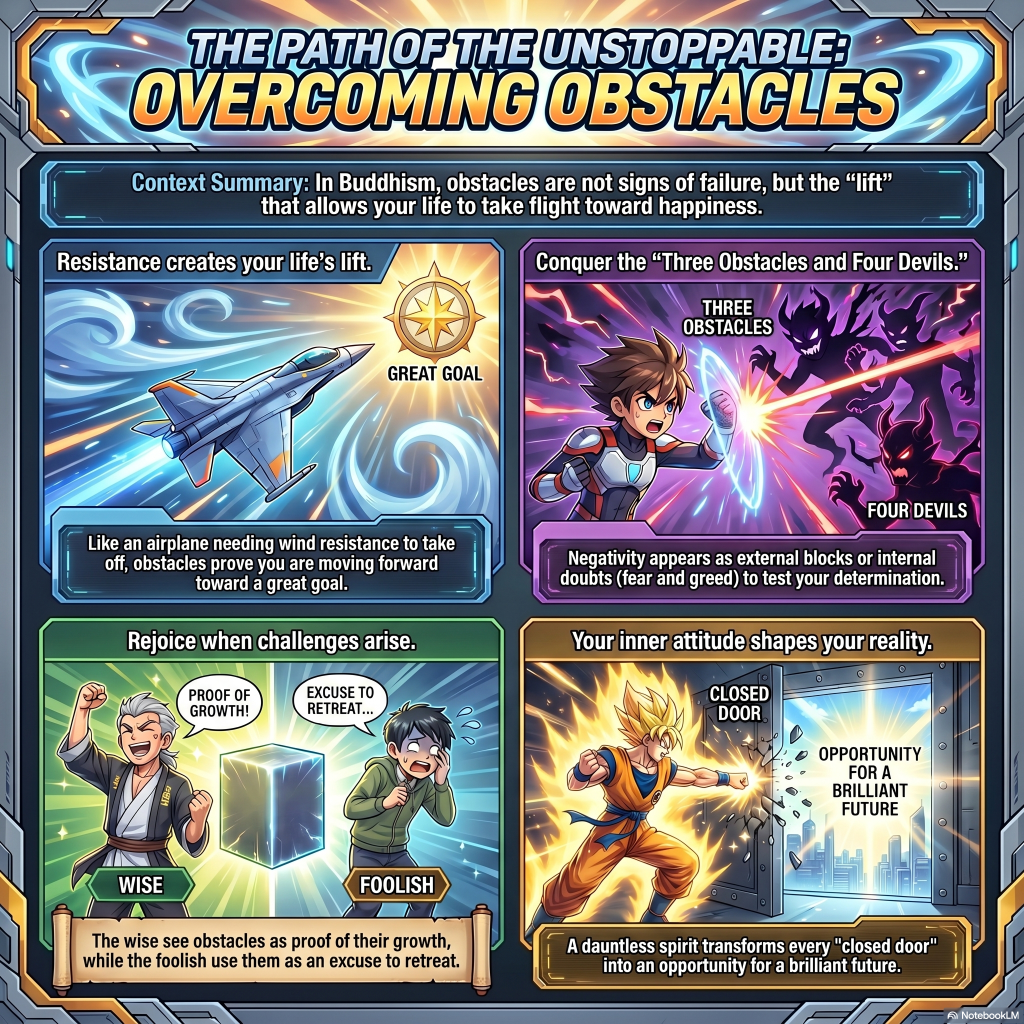
We’ve all been there. You start the year with a fire in your belly, a gym membership in hand, and a resolve to finally write that book or heal that relationship. But then, a few weeks in, the “New Year’s fade” sets in. Or worse, the moment you decide to step up, life seems to throw a curveball—a sudden bill, a cold, or a conflict at work.
It’s tempting to see these hurdles as a sign from the universe to stop. But in Nichiren Buddhism, we look at it through a completely different lens. What if those sudden problems weren’t “stop signs” at all? What if they were actually the “lift” you need to take flight? In this philosophy, encountering negativity after making a positive change is actually a high-five from the universe—it’s the absolute proof that you are moving in the right direction.
Resistance is the “Lift” that Makes You Fly
Think about how an airplane works. An aircraft doesn’t just drift into the sky; it needs to build up incredible speed on the runway. As it moves faster, it encounters air resistance. It’s that very resistance that creates the “lift” necessary to keep the plane airborne and propel it toward its destination. Without the wind pushing against the wings, the plane would never leave the ground.
In our lives, the stronger the “positive cause” we make—whether that’s working toward our own growth or contributing to the happiness of others (what we call the kosen-rufu movement)—the stronger the negative resistance will be. This shift in perspective is incredibly empowering. When you feel the “wind” of life pushing back, you can smile and realize it’s not a barrier; it’s the propulsion required for your breakthrough.
The “Three Obstacles and Four Devils” Roadmap
To navigate the storms of life, Buddhism provides us with a roadmap called the “three obstacles and four devils.” If we know the names of the signs on the road, we aren’t as easily frightened when we see them.
The Three Obstacles usually manifest as external environmental blocks:
- The obstacle of earthly desires: Negativity fueled by greed, anger, or foolishness.
- The obstacle of karma: Challenges arising from our own past negative actions.
- The obstacle of retribution: Resistance from those in authority or even family members who may try to obstruct our path.
The Four Devils (or hindrances) are more internal and insidious:
- The devil of earthly desires: Being swayed by our own cravings or delusions.
- The devil of the five components: Physical or mental illness that saps our energy.
- The devil of death: The paralyzing fear or doubt that arises after the loss of a loved one.
- The devil king of the sixth heaven: The personification of extreme, life-force-sapping negativity.
It’s worth noting that while there are three external obstacles, there are four internal devils. This reminds us that while we should be aware of our surroundings, we must keep an even closer watch on our own inner state. As Nichiren Daishonin famously wrote:
“There is definitely something extraordinary in the ebb and flow of the tide, the rising and setting of the moon, and the way in which summer, autumn, winter and spring give way to each other. Something uncommon also occurs when an ordinary person attains Buddhahood. At such a time, the three obstacles and four devils will invariably appear, and the wise will rejoice while the foolish will retreat.”
Understanding the “Devil King” (And Why He’s Worried About You)
The “Devil King of the Sixth Heaven” sounds like a literal monster, but Buddhism describes him more like a ridiculous, high-drama character in a pantomime. He represents the peak of negativity that is terrified of you becoming happy and independent.
Why? Because when you reveal your “Buddha nature,” you not only free yourself from suffering but you empower everyone around you to do the same. This “vexes” the Devil King because he loses his domain. In the texts, he’s described as summoning his “underlings” from across the “threefold world” (the worlds of desire, form, and formlessness) to harass you. If that doesn’t work, he tries to possess the minds of your friends or people in power to threaten you.
By demystifying this force, we can see negativity for what it is: a desperate, last-ditch effort by our own delusions to stop our progress. When things get weirdly difficult, you can almost hear the Devil King’s frustration—and that’s a sign you’re winning.
The Wise Rejoice: How to React to Trouble
The difference between success and failure isn’t the absence of problems; it’s our reaction to them. The “foolish” retreat when things get hard, but the “wise” actually rejoice.
Why rejoice in a struggle? Because the appearance of these obstacles is the “guarantee” that you are close to a major enlightenment. The great teacher T’ien-t’ai offered a vital warning on how to stay the course:
“One should be neither influenced nor frightened by them. If one falls under their influence, one will be led into the paths of evil. If one is frightened by them, one will be prevented from practising the correct teaching.”
When we get scared, we stagnate. When we keep a steady, uninfluenced heart, we move through the barrier.
The Oneness of Self and Environment
A core principle in my practice is “the oneness of self and the environment.” This means our surroundings are essentially a mirror reflecting our inner life. If we hold onto a pessimistic heart, we tend to draw out negative responses from the world around us. Conversely, a positive, determined inner state draws out harmony.
However, we have to be honest with ourselves. Sometimes being late for a meeting isn’t a “spiritual attack”—it’s just bad planning or transport issues! True “negativity” is that specific energy that tries to make you abandon your belief in yourself. The environment responds to our inner breakthrough; as we change our hearts, the “obstacles” in our environment eventually transform into the very tools of our victory.
The “Come At Me” Mindset: Forging an Unshakable Spirit
Daisaku Ikeda often teaches that difficulties aren’t walls—they are “doors waiting to be opened.” Whether a trial is a misfortune or a stroke of good luck depends entirely on your resolve. We forge our spirit by challenging these things head-on. The ideal state is one of “profound elation” when things get tough.
In Nichiren Buddhism, we use the practice of chanting Nam-myoho-renge-kyo to raise our life-condition. This allows us to look at a mountain and say:
“With a dauntless spirit, we can lead a cheerful and thoroughly enjoyable life. We can develop a self of such fortitude that we look forward to life’s trials and tribulations with a sense of profound elation and joy: ‘Come on obstacles! I’ve been expecting you! This is the chance that I’ve been waiting for!’”
Your Heart is What Matters Most
At the end of the day, everything is determined by your inner resolve. The Argentine poet Almafuerte once wrote: “To the weak, difficulty is a closed door. To the strong, however, it is a door waiting to be opened.”
By tapping into your Buddha nature, you gain the capacity to transform any obstacle into a stepping stone for growth. Your heart is the most powerful tool you own. It determines whether you see a barrier or a breakthrough.
The next time you face a “closed door” in your life, take a breath and remember the airplane. Will you see the resistance as a reason to stop, or will you recognize it as the sign that you are finally ready to take flight?
